
Why Landing Surfaces Matter in Gymnastics Training
Gymnastics is often associated with strength, flexibility, and skill—but one of the most overlooked aspects of the sport is landing.
Every jump, flip, and dismount ends the same way: with the body absorbing force. And that force is significant.
Elite gymnasts do an average of 200 landings per week (Glynn et al., 2022). Research shows that gymnastics landings can generate multiple times an athlete’s bodyweight, sometimes exceeding 10× bodyweight depending on the skill and height (Gittoes & Irwin, 2012).
These kinds of high-impact landings are most commonly associated with higher-level skills like saltos and dismounts—which is where specialised equipment such as foam pits and resi systems are typically used.
However, at Mokara Gymnastics, we introduce these training surfaces early—even in our recreational programmes—so athletes can begin developing safe landing habits and proper technique from the start.
The question isn’t whether impact exists—it’s how that impact is managed.
How Landing Forces Work in Gymnastics
When a gymnast lands, the body must decelerate quickly. The ankles, knees, and hips work together to absorb and distribute force.
Biomechanics research shows:
- Faster stopping = higher peak force
- Better technique (e.g. deeper knee bend) = lower impact
- Poor alignment = higher injury risk
Longitudinal studies on elite gymnasts highlight how landing mechanics—especially at the ankle—relate closely to injury patterns over time (Glynn et al., 2022).
It’s also not just how you land, it’s how the surface helps absorb that force.
Why Gymnastics Landing Surfaces Matter
From a physics perspective, landing force depends on how quickly the body is brought to a stop.
- Hard surfaces → shorter stopping time → higher peak force
- Softer surfaces → longer stopping time → lower peak force
This is why gymnastics training uses different surfaces.
Research on tumbling landings shows that how energy is absorbed by the surface significantly affects the stress placed on the body (Hao et al., 2018).
The surface you land on directly affects how much stress your joints absorb.
What Is a Resi Pit in Gymnastics? (Beginner Guide)
A resi pit is a multi-layered landing system designed to reduce impact while still allowing gymnasts to land on their feet.
Unlike a foam pit (where athletes sink in), a resi pit typically includes:
- High-density foam layers
- Additional foam blocks or padding
- Sometimes have an additional trampoline or spring base underneath
This design allows the surface to:
- Absorb force gradually
- Extend deceleration time
- Reduce peak landing impact
Most importantly, it still allows athletes to practice real landing mechanics.
Foam Pit vs Resi Pit: Key Differences
Both are essential in gymnastics training, but they serve different purposes.
Foam Pit
- Lowest impact
- Best for learning new or high-risk skills
- Minimal stress on joints
- Less realistic landing feel
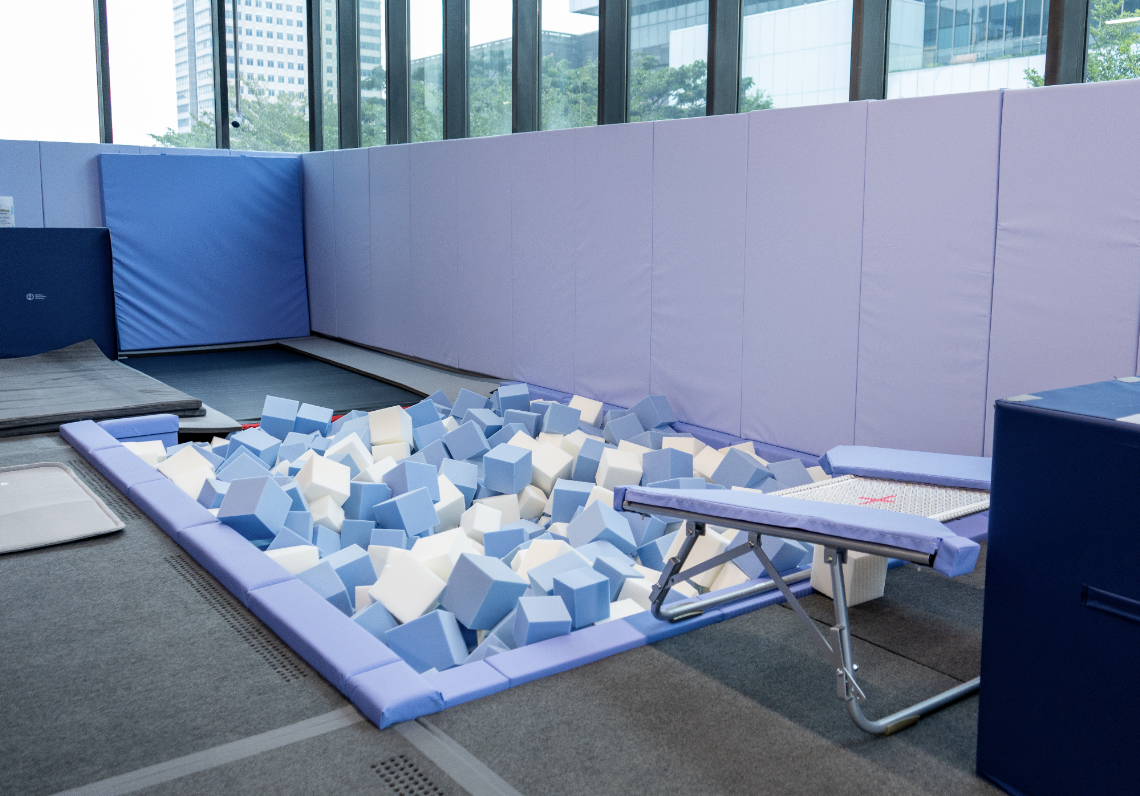
Resi Pit
- Moderate impact reduction
- Allows upright landings and stabilisation
- Better transfer to competition landings
- Builds confidence and control
Why Trampoline-Based Resi Systems Are More Effective
At Mokara, 3 out of our 5 resi pits are built over trampoline-based systems.
This enhances both safety and performance by:
- Increasing time over which force is absorbed
- Reducing sudden impact spikes
- Providing slight rebound for smoother landings
How Better Surfaces Improve Training Volume
Lower-impact surfaces don’t just make training safer—they allow athletes to train more effectively & efficiently.
When each landing places less stress on the body:
- Athletes can perform more repetitions
- Skills can be practiced more consistently
Gymnastics is a repetition-based sport. Progress comes from trying, refining and repeating.
The right surfaces allow higher training volume without proportionally increasing strain.
Progression in Gymnastics Training (Why It Matters)
Athletes don’t go straight to hard landings—and they shouldn’t.
Effective training follows a structured progression:
- Foam pit → safe skill learning
- Resi pit → controlled landing development
- Competition floor → performance readiness
This approach helps athletes:
- Build physical preparation
- Develop consistent technique
- Reduce injury risk
Research consistently shows that sudden exposure to high-impact landings without preparation increases injury risk.
Why This Matters for Kids and Adults in Singapore
Whether recreational or competitive, landing surfaces matter for all gymnasts.
Competitive athletes
- Higher difficulty = higher landing forces
- More repetitions = greater cumulative load
- Proper surfaces help manage long-term stress
Recreational gymnasts
- Bodies are still developing
- Technique is still being learned
- Safer environments build confidence
It matters for both skill progression and long-term holistic health.
Training at Mokara Gymnastics Academy (Singapore)
At Mokara Gymnastics in Singapore, our facility is designed around progressive training and athlete longevity.
We use:
- Foam pits for safe skill development
- Resi pits for controlled landings
- Trampoline-based systems to reduce impact
- Competition surfaces for performance readiness
This allows athletes to train in a way that balances skill development, safety, and long-term progression.
Training for Longevity
Gymnastics will always involve impact—and that’s not entirely a bad thing.
When managed properly, impact-based activity helps support:
- Bone density
- Strength development
- Long-term resilience
The key is how that impact is introduced and progressed.
By combining:
- proper physical preparation
- sound technique
- and the right training surfaces
athletes can train smarter, progress safely, and stay in the sport longer.

